Your Shopping Cart | Your Account Information | Catalog Quick Order | Customer Service | Order Status | Contact Us
RadioSpirits.com

HOMENEW RELEASESBESTSELLERSCLEARANCEBOOKSDVDsMUSICDOWNLOADS

AboutBlogOur Radio Show SEARCH   KEYWORD

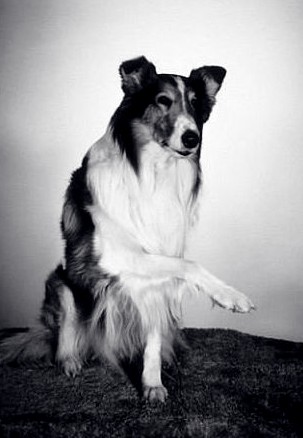
“Good girl!”


Family members of all sizes and ages have watched with admiration and fascination at the adventures of the world’s most famous collie dog, Lassie, ever since the first of seven films produced at M-G-M premiered in 1943 with Lassie Come Home.  (This movie, starring Roddy McDowall and Elizabeth Taylor, was based on the novel by author Eric Knight, who expanded a short story he had written for The Saturday Evening Post two years earlier.)  The wonder canine later came to TV in the fall of 1954, and stayed there for nearly twenty years (Lassie ended its original network run in 1971, and was seen in syndication for a few years afterward); later versions of Lassie would turn up in the 1980s (as The New Lassie) and the 1990s…as well as additional theatrical movies from that time span as well.  My curmudgeonly father once cracked that if that were really the original dog from the movies, at its age it would be more likely to lie around and do nothing as opposed to helping out people in distress.  Of course, all of the Lassies over the years have been played by male collies (despite the character being female), descendants of “Pal,” the dog from the 1943 film.

Lassie has been the subject of novels, comic books, toys and practically every other form of media…and currently hawks her own line of dog food, as well as hosts a pet show seen on many PBS stations.  But would you be surprised to learn that the super collie also had her own radio show?  Sixty-five years ago on this date, The Lassie Show debuted on the ABC Radio network—with M-G-M’s famous canine star trained to bark, whine and snarl on cue by her longtime trainer Rudd Weatherwax.  Lassie hadn’t achieved the mantle of “star” at this point in her career, so she was forced to peddle a brand of dog chow other than her own.  For the show’s three-year run (it ran for a year on ABC before switching to NBC in 1948, where it was heard until May 27, 1950), Red Heart Dog Food, a product of the John Morrell Packing Company, was Lassie’s sponsor.

The stories on this quarter-hour show were fairly simple and straightforward; interestingly, the show’s creative team hadn’t yet stumbled onto the successful TV formula where she had to pull Timmy out of a well every week.  Instead, Pal/Lassie played a variety of dogs—many of them collies, but occasionally they’d mix it up and assign her the part of a German shepherd or Irish setter.  The scripts were inspired by real-life stories submitted by listeners, with “The Red Heart Award for Valor” going to a canine who performed above and beyond the call of duty.  Accompanied by Weatherwax’s narration and an organ (John Duffy, who played incidental music and the show’s theme, “Comin’ Through the Rye”), Lassie would emote alongside many of radio’s finest utility players, including John Dehner, Betty Arnold, Don Diamond, Ken Christy, Martha Wentworth, and Ruth Parrott.  On the occasions when Lassie was temperamental, animal imitator Earl Keen was on hand as the collie’s “understudy” (in addition to playing the parts of other dogs).

The scripts for Lassie were written by Hobart Donovan, with direction by Harry Stewart and production by Frank Ferrin.  The show’s longtime announcer was Charles Lyon.

Ray Bradbury (1920-2012)

In his reference book The Great American Broadcast, author Leonard Maltin relates an anecdote of how future science-fiction/fantasy author Ray Bradbury talked himself into a “job” on George Burns & Gracie Allen’s radio show.  The brash youngster, fourteen at the time, coaxed straight man Burns into letting him and a friend attend the comedy duo’s broadcasts, and shortly after that he began to turn in a weekly script for them.  “He was incredibly kind to me, read my dreadful Burns and Allen scripts, said they were great, said I was a born writer.”  (Bradbury, in telling the story many years later, informed Maltin that not only did the couple eventually use one of his routines, but in 1982, at an awards ceremony honoring Steven Spielberg, he related the story of his apprenticeship to the audience…and had Burns rush over to him when it was done, saying: “Was that you?  Was that you?  I remember you!”)

Bradbury never became a permanent part of the Burns and Allen writing staff (they had John P. Medbury…but no Bradbury), but his participation in radio would become quite prominent once Ray began making his first short story sales to magazines in the 1940s.  Bradbury recounted to Maltin that he finally summoned up the gumption to contact William Spier (the producer of Suspense) about selling him some of the stories he had written for Weird Tales magazine…and Spier graciously invited him over to the house to discuss the prospect, where the author would drink cocktails and rub shoulders with the likes of Orson Welles, Agnes Moorehead and Ava Gardner.  “Radio’s outstanding theatre of thrills” used quite a few Bradbury tales on the anthology program, including “Riabouchinska,” “The Screaming Woman,” “The Crowd,” and “Kaleidoscope.”  Other shows that availed themselves of Ray’s talent include The Molle Mystery Theatre, Radio City Playhouse, The CBS Radio Workshop, NBC Short Story…and Suspense’s “sister” show, Escape.

It would be the science-fiction radio programs Dimension X (1950-51) and the later X-Minus One (1955-58) that would make full use of the Bradbury library, presenting such tales (often adapted on both programs) as “There Will Come Soft Rains,” “The Veldt,” “Marionettes, Inc.,” “And the Moon Be Still as Bright,” and “Mars is Heaven.”   One of Bradbury’s classic stories, “Zero Hour,” not only appeared on both of the “X’s” but on Suspense and Escape as well.  In the 1970s, the short-lived science-fiction radio drama Future Tense had a go-round at “Zero Hour” (as well as “Mars is Heaven”).  In 1981 National Public Radio presented Bradbury 13, a series of thirteen dramatic broadcasts that adapted more of the author’s stories like “Dark They Were, and Golden-Eyed” and “A Sound of Thunder.”  (This anthology was the recipient of a Peabody Award.)

Hearing of Bradbury’s passing at the age of 91 on June 5, I mentioned the news to my parents…and my mother said solemnly, “I don’t think I’ve ever read anything by Bradbury.”  My response to this was that I read everything of his I could get my hands on: his large number of short stories (he wrote nearly 600) in collections like Dark Carnival (which contained Bradbury’s classic chiller, “The Small Assassin”—a tale that kept me awake at night for a week), The Martian Chronicles, and The Illustrated Man; plus novels like Fahrenheit 451 and Something Wicked This Way Comes.  To say Ray’s writing was an influence on me would be a mild understatement—in some ways, I’m a writer because I fell in love with his work (I even did my high school English class research paper on him).  His incalculable prose has also been adapted for comic books, movies (the 1953 monster film The Beast from 20,000 Fathoms is based on Bradbury’s “The Fog Horn”) and TV shows (The Twilight Zone, Alfred Hitchcock Presents)—notably The Ray Bradbury Theater, an anthology featuring dramatic adaptations of his stories that was seen on the HBO and USA networks from 1985 to 1992.

Before his death, Ray Bradbury had already decided on his epitaph: his headstone will read “Author of ‘Fahrenheit 451.’”  This does the man somewhat of a disservice—his works were science-fiction based, but they also contained elements of fantasy, horror…and even humor; his short stories will still be read by generations after his passing, and many of them were the basis of some of the best radio drama ever broadcast.  He made the sci-fi genre “respectable,” argues author Ted Gioia in a Salon tribute. “Bradbury was much more than a teller of high-tech tales. No science fiction author of his generation had a more polished or more poetic prose style — a skill that stood out all the more given the slapdash sentences of his pulp fiction contemporaries. But Bradbury’s greatest skill was his ability to inspire readers to reflect deeply on our society and values, even when his books dealt with Mars or the future or some other tried-and-true genre concept.”

R.I.P., Ray Bradbury…you will be sorely missed.

The blog post you’re about to read is true…

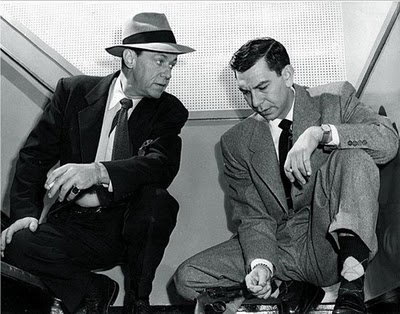
Radio actor Jack Webb was fortunate in that he had just landed a small role as a lab technician in a 1948 Eagle-Lion film noir entitled He Walked by Night…and in between takes, he would find himself engaged in conversation with L.A. police Sergeant Marty Wynn, who was serving as a technical adviser on the movie.  The two men were in agreement that what radio needed was a show that concentrated on the day-to-day routine of the average cop-on-the-beat, who often solved crimes through the expending of shoe leather: questioning suspects and witnesses, gathering evidence, etc.  Most radio crime dramas of the day were comprised of wisenheimer gumshoes that made the police look like idiots as they cracked cases within a half-hour span (Webb himself had played similar shamuses on such series as Pat Novak for Hire and Jeff Regan, Investigator).

With the endorsement of L.A.P.D. chief Clemence B. Horrall and an audition record co-scripted by writer James E. Moser, Webb sold NBC on the idea of Dragnet at a time when the network’s fortunes had been somewhat dissipated by the infamous “talent raids” of CBS president William Paley.  Debuting on this date in 1949, Dragnet slowly started to build a loyal audience of listeners who loved the show’s realism, underplayed acting and sharp dialogue.  Webb himself took on the role of Sergeant Joe Friday, a dedicated police detective once described by OTR historian John Dunning as “a cop’s cop, tough but not hard, conservative but caring.”  Radio veteran Barton Yarborough was Friday’s partner, Sgt. Ben Romero (a marked contrast to the single Friday in that Ben was a devoted family man), whose untimely death in December 1951 (just as the series had made its television debut on an edition of Chesterfield Sound Off Time) gave Joe a revolving door of partners before choosing another radio vet, Ben Alexander, to play Detective Frank Smith.

There had been other attempts to do realistic police shows (as far back as the 1930s, with CBS’ West Coast program Calling All Cars) but none of them would have the impact of the seminal Dragnet; it became the yardstick by which all police procedurals would be measured, and lasted on radio until 1955 (with repeats of the series heard until 1957).  Its history on the “boob tube” would be even lengthier; it ran from 1951 to 1959 in its initial run, and then was revived in January 1967 for a three-year-stint that could have continued longer had creator Webb not set his sights on becoming a major TV auteur (he created the successful Adam-12 series in 1968, and would add another smash five years later with Emergency!).  Today’s generation has come to laugh at the show because of its familiarity with the 1960s incarnation (a version marked by its fervent pro-police moralizing and anti-counterculture screeds)…but if you get the opportunity to check out the show in its prime, you’ll hear for yourself what made Dragnet such a groundbreaking piece of radio drama.

“There’s something about the sound of my own voice that fascinates me…”

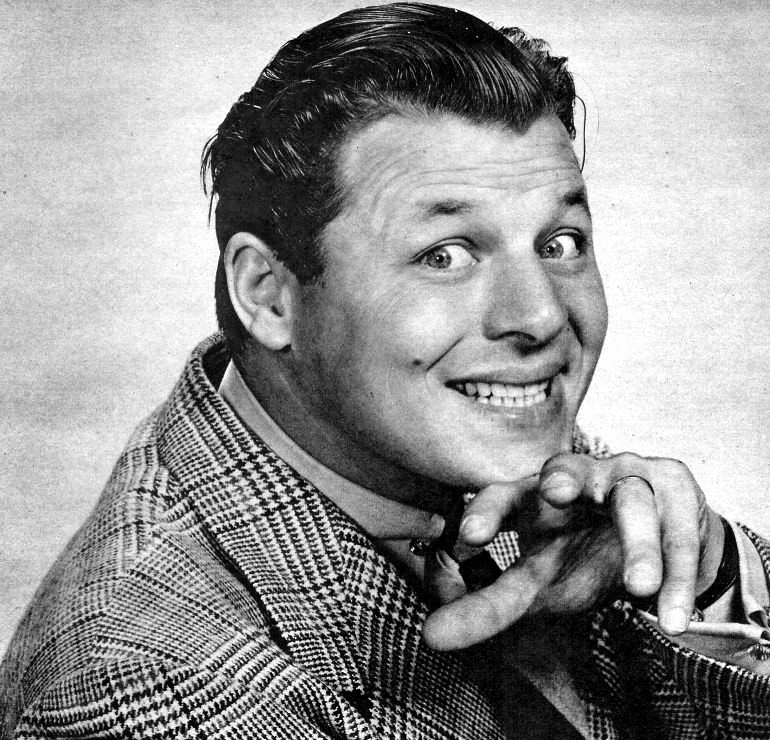
Sixty-nine years ago on this date, CBS premiered The Jack Carson Show: a half-hour situation comedy starring the comic actor famous at that time for such films as Love Crazy, The Male Animal and The Hard Way (with his frequent onscreen partner, Dennis Morgan).  A series with strong echoes of both the Jack Benny and Bob Hope programs, Carson essentially played himself; a Hollywood celebrity living at 22 North Hollywood Lane in a residence staffed with the go-to character actor for butlers, Arthur Treacher, as his valet and second banana Dave Willock as his nephew “Tugwell.”  Other supporting players on the show included Irene Ryan, Eddie Marr (as Jack’s agent), Agnes Moorehead, Elizabeth Patterson, child actress Norma Jean Nilsson…and the ubiquitous Mel Blanc.

Though he proudly embraced his Milwaukee, Wisconsin roots, John Elmer Carson was actually born in Carman, Manitoba in 1910 before his parents migrated to the town Carson would later help to make famous.  His show business career began when he teamed up with the aforementioned Mr. Willock in a vaudeville act (Willock and Carson)—but with the decline of that form of stage entertainment in the mid-thirties, both men decided to try their luck in Hollywood, getting hired for bit parts at R-K-O in 1936.  Both Willock and Carson were able to secure a lot of feature film work—but it was Jack who hit the “Jack-pot,” appearing in minor roles in film classics such as Stage Door, Bringing Up Baby and Destry Rides Again.  Carson’s movie fortunes took an upswing when he was hired by Warner Brothers in the 1940s (thanks to his budding radio career), appearing in the likes of Arsenic and Old Lace, Roughly Speaking…and the film most consider his finest acting work, 1945’s Mildred Pierce (“I’m so smart it’s a disease!”).

Willock and Carson broke into radio with a celebrated appearance on Bing Crosby’s Kraft Music Hall in 1938, which led to the two of them being hired for the NBC West Coast series Signal Carnival in 1941, and the coast-to-coast Camel Comedy Caravan in 1943.  The Comedy Caravan was a preview of how Carson’s self-titled program (sponsored by Campbell Soups) eventually developed; Jack played a brash ladies’ man (like Bob Hope) who was also a little stingy (like Jack Benny) beset by both butler “Treacher” and nephew “Tugwell,” not to mention other assorted friends and relatives.  Carson’s show continued on CBS until 1947, when he jumped ship to NBC to become the male lead (alongside future school teacher Eve Arden) on The Sealtest Village Store…and then when that program folded after a season, he was back on CBS for another year (still hawking Sealtest), finally calling it a wrap in July 1949. Carson later did a five-day-a-week variety series that ran from October 3, 1955 to December 20, 1956.

One of the most memorable gags on The Jack Carson Show was the star’s doorbell, which combined “the features of a carnival wheel, an alarm clock, a fire alarm and a factory whistle,” according to OTR historian John Dunning.

The Fabulous Frank Morgan

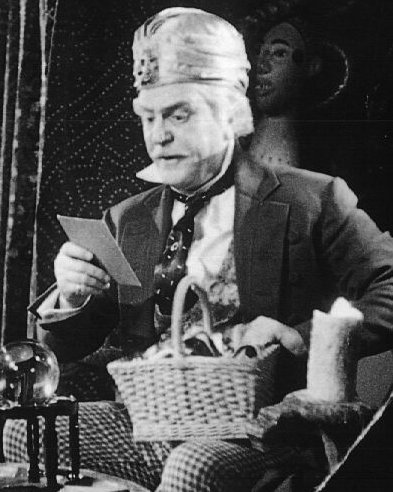
On this date in 1890, actor-comedian Frank Morgan came into this world…born Frances Phillip Wupperman in New York City.  The youngest of eleven children (six girls, five boys), the Wupperman family were quite well-to-do and were thus able to give Frances a fine education at Cornell University (where he also joined the renowned Phi Beta Kappa fraternity)—but upon graduation, he decided to follow in his older brother Ralph’s (Raphael Wupperman) footsteps and become an actor.  His success on the Broadway stage translated into equal fame in silent films…though it was with the advent of talkies that Morgan really made his mark.  Frequently cast as a befuddled but well-meaning middle-aged eccentric, his films include The Half-Naked Truth (1932), Hallelujah, I’m a Bum (1933), Bombshell (1933), The Good Fairy (1935), The Shop Around the Corner (1939), The Mortal Storm (1940) and The Human Comedy (1943).  He was twice nominated for acting Oscars (for 1934’s The Affairs of Cellini and 1942’s Tortilla Flat) but his best-known role (even to those who aren’t necessarily classic movie fans) remains the titular charlatan of The Wizard of Oz (1939), which remains a timeless favorite for both old and young alike.

As an M-G-M contract player, Morgan also made frequent appearances as the resident comic on the studio’s Good News (of 1938) program from 1937 to 1940…and in the fall of 1940, took over the program (along with Fanny Brice as “Baby Snooks”) when it was shortened to a half-hour and christened Maxwell House Coffee Time.  Brice quit the program at the end of the 1943-44 season to start her own show in the fall and Morgan soldiered on for another year (with Robert Young and Cass Daley in support) afterward…then made his way to The Kraft Music Hall at a time when the show was having to do with the temporary absence of its star, Bing Crosby.  A 1946 summer sitcom called The Fabulous Dr. Tweedy (featuring Frank as an absentminded college professor) garnered enough positive buzz to run through the 1946-47 season, and Morgan’s final radio gig was as one of the stars of The Old Gold Show (also called The Don Ameche Show), which allowed him to match wits with stars Ameche and Francis Langford.  (This series is where many of “The Bickersons” sketches were performed…and sadly, in some cases “The Bickersons” routines are all that remain from those broadcasts—though some of the scripts have been reprinted in book form.)  Morgan passed away on September 18, 1949…but he left behind a true legacy of movie memories and radio laughter.

“Murray Hill 4-0098…”

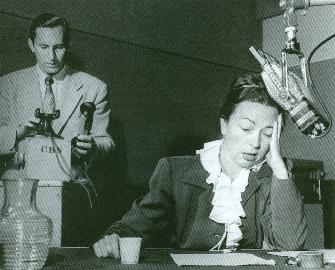
Sixty-nine years ago on this date, “radio’s outstanding theatre of thrills,” Suspense, first presented the most popular episode in its nearly twenty-year broadcast history (1942-62). Written by Lucille Fletcher (who was inspired by a disagreement she had with an elderly woman at a drugstore), “Sorry, Wrong Number” told the story of an invalid who overhears a phone conversation between two men who are carrying out plans for a murder. The role of Mrs. Elbert Stevenson, the woman who inadvertently receives “too much information,” was played by one of the premier actresses in the history of the medium: Agnes Moorehead. Her tour-de-force performance in the tense half-hour drama is one of the most memorable from the Golden Age of Radio. The response to the program was such that “Sorry, Wrong Number” would be featured on Suspense an additional seven times (its last presentation was on February 14, 1960, although that broadcast was a repeat of a performance from 1957).

The thirty-minute drama was later expanded into a 1948 film that, sadly, did not use Moorehead. The movie version relied on the services of Barbara Stanwyck, who received an Academy Award nomination as Best Actress that year for her performance. (Stanwyck would also play the part of Mrs. Stevenson in a Lux Radio Theater adaptation of the film, which was broadcast on January 9, 1950.) The Fletcher play was also modified a number of times for television (notably for a 1954 episode of TV’s Climax! and a 1989 TV-movie starring Loni Anderson). But, when the balance sheet is tallied up, it’s still the Agnes Moorehead version that stands head and shoulders above the rest.

Fletcher was dubbed “that most original of radio writers” by no less an authority than Orson Welles (who would go on to turn her script for “The Hitch-Hiker” into another memorable radio highlight).